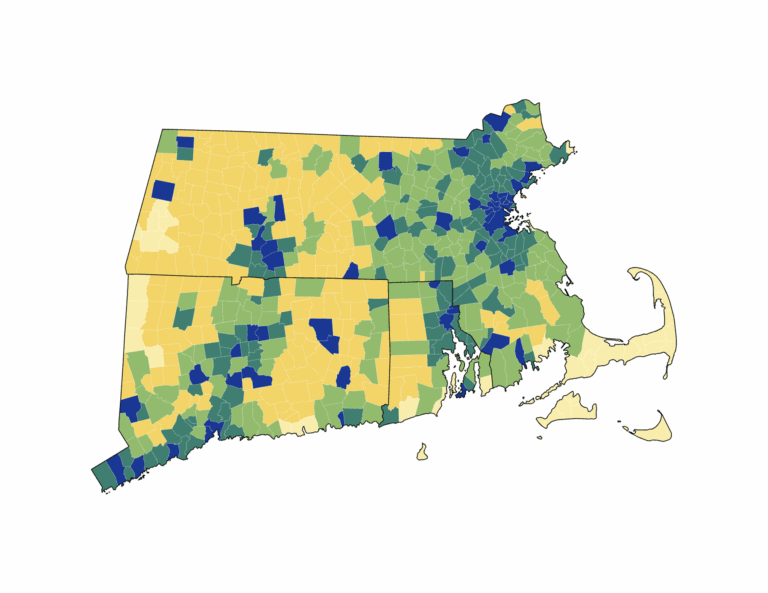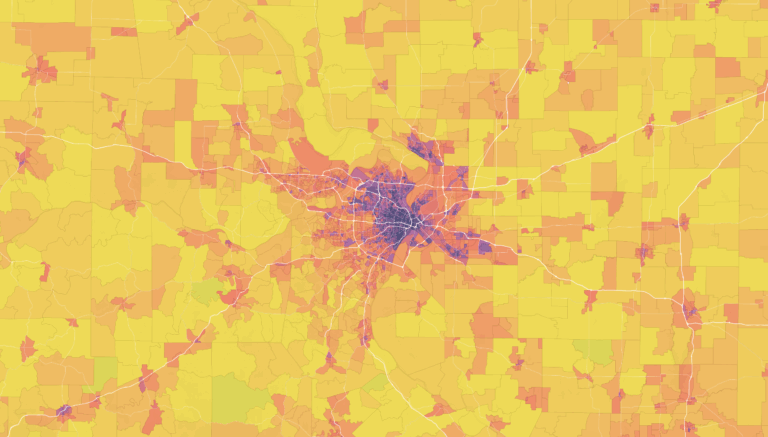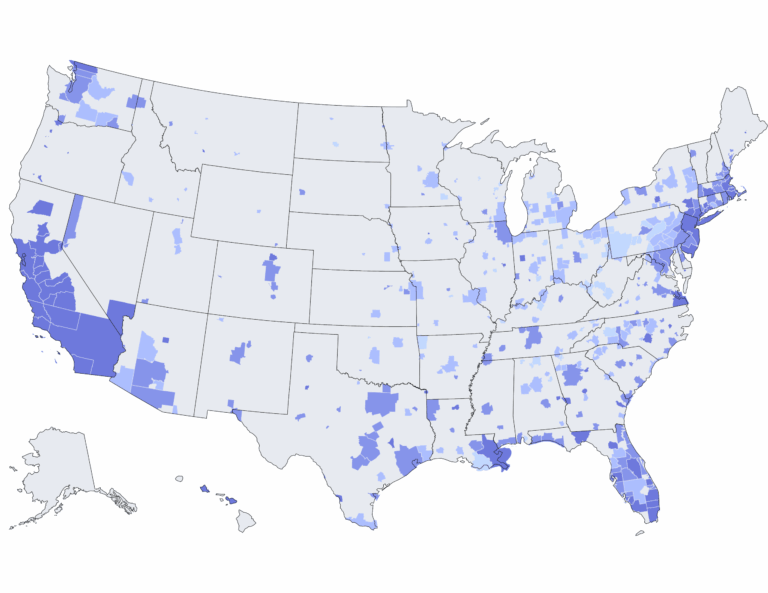

The 2024 ACS took a little bit longer than usually to be released, but now that its out we had a chance to compare some of the significant differences between 2023 and 2024.
The American Community Survey is the gold standard for demographic and housing data, but its 5-year estimates inherently look backward, the 2024 release reflects conditions averaged across 2020-2024. CommunityScale’s methodology uses ACS and PUMS as a foundational layer and then supplements it with fresher, higher-frequency data for home values, rental indices, inventory metrics, FRED (mortgage rates and economic indicators), BLS (Consumer Price Index for inflation adjustment), and HUD (Area Median Income). By blending the ACS’s comprehensive demographic detail with these more current market signals, CommunityScale can produce housing forecasts and affordability analyses that are both demographically grounded and responsive to real-time market conditions.

Population
The Sun Belt mega-trend continued
Texas added 548,080 people (+1.85%) and Florida added 487,197 (+2.22%) together accounting for roughly half of all US growth. North Carolina (+146k), Georgia (+118k), and Arizona (+111k) rounded out the top five.
Population Growth: Fastest-Growing States
ACS 5-Year Estimates, indexed to 2010 = 100

| State | 2024 Pop | Change | % Change |
|---|---|---|---|
| Texas | 30,188,424 | +548,080 | +1.85% |
| Florida | 22,416,077 | +487,197 | +2.22% |
| North Carolina | 10,730,404 | +146,064 | +1.38% |
| Georgia | 10,940,407 | +117,817 | +1.09% |
| Arizona | 7,378,838 | +110,663 | +1.52% |
| South Carolina | 5,296,225 | +83,451 | +1.60% |
| Tennessee | 7,066,383 | +80,301 | +1.15% |
| New Jersey | 9,343,809 | +76,795 | +0.83% |
| Washington | 7,816,116 | +75,132 | +0.97% |
| Utah | 3,392,331 | +61,144 | +1.84% |
| Source: Table B01001 | |||
Shrinking states
New York was the only state that lost significant population (-19,954), followed by Louisiana (-9,064), West Virginia (-6,089), Mississippi (-4,659), and Hawaii (-400). Illinois barely held steady at +2,145.
Population Change: Slow-Growth and Declining States
ACS 5-Year Estimates, indexed to 2010 = 100

| State | 2024 Pop | Change | % Change |
|---|---|---|---|
| New York | 19,852,366 | -19,954 | -0.10% |
| Louisiana | 4,611,961 | -9,064 | -0.20% |
| West Virginia | 1,778,373 | -6,089 | -0.34% |
| Mississippi | 2,946,779 | -4,659 | -0.16% |
| Hawaii | 1,445,235 | -400 | -0.03% |
| Illinois | 12,694,798 | +2,145 | +0.02% |
| Source: Table B01001 | |||
Fastest-growing large cities (100k+)
Houston (+27.8k), Fort Worth (+21.9k), and San Antonio (+20.9k) led in absolute terms. Mobile, AL was a standout with a +9.9% growth rate, the highest among all cities over 100k. Other notable fast growers included Port St. Lucie, FL (+5.5%), Cape Coral, FL (+4.4%), and Frisco, TX (+4.3%).
Population Growth: Fastest-Growing Large Cities
Cities over 100K population, ACS 5-Year Estimates, indexed to 2010 = 100

| City | 2024 Pop | Change | % Change |
|---|---|---|---|
| Houston, TX | 2,328,253 | +27,834 | +1.21% |
| Fort Worth, TX | 963,194 | +21,883 | +2.32% |
| San Antonio, TX | 1,479,835 | +20,881 | +1.43% |
| Mobile, AL | 203,416 | +18,319 | +9.90% |
| Charlotte, NC | 903,844 | +17,561 | +1.98% |
| Phoenix, AZ | 1,642,323 | +17,491 | +1.08% |
| Jacksonville, FL | 977,670 | +15,931 | +1.66% |
| Miami, FL | 459,745 | +13,082 | +2.93% |
| Seattle, WA | 754,195 | +12,755 | +1.72% |
| Port St. Lucie, FL | 232,491 | +12,038 | +5.46% |
| Source: Table B01001 | |||
Cities losing population
NYC lost the most people of any city (-32,358), followed by Memphis (-10,083) and San Francisco (-6,086). St. Louis, New Orleans, Baltimore, and Jackson, MS also posted notable declines.
Population Change: Declining Large Cities
Cities over 100K population, ACS 5-Year Estimates, indexed to 2010 = 100

| City | 2024 Pop | Change | % Change |
|---|---|---|---|
| New York, NY | 8,483,844 | -32,358 | -0.38% |
| Memphis, TN | 618,980 | -10,083 | -1.60% |
| San Francisco, CA | 830,235 | -6,086 | -0.73% |
| St. Louis, MO | 288,512 | -4,597 | -1.57% |
| New Orleans, LA | 371,853 | -4,182 | -1.11% |
| Baltimore, MD | 573,243 | -3,950 | -0.68% |
| Jackson, MS | 146,631 | -3,196 | -2.13% |
| Long Beach, CA | 455,548 | -2,943 | -0.64% |
| Milwaukee, WI | 566,973 | -2,783 | -0.49% |
| Philadelphia, PA | 1,579,706 | -2,726 | -0.17% |
| Source: Table B01001 | |||
Metro area trends
The Dallas-Fort Worth (+178k, +2.3%) and Houston (+168k, +2.3%) metros led, followed by Miami (+110k) and Phoenix (+88k). Austin (+2.9%) and Orlando (+2.7%) posted the highest growth rates among large metros. On the flip side, LA-Long Beach-Anaheim lost 38k people, and San Francisco-Oakland lost 8.6k.
Metro Area Population Trends
Major metro areas, ACS 5-Year Estimates, indexed to 2010 = 100

| Metro | 2024 Pop | Change | % Change |
|---|---|---|---|
| Dallas-Fort Worth-Arlington, TX | 7,985,590 | +178,035 | +2.28% |
| Houston-Pasadena-The Woodlands, TX | 7,442,788 | +168,074 | +2.31% |
| Miami-Fort Lauderdale-WPB, FL | 6,249,291 | +110,415 | +1.80% |
| Phoenix-Mesa-Chandler, AZ | 5,028,754 | +87,548 | +1.77% |
| Austin-Round Rock-San Marcos, TX | 2,426,592 | +69,095 | +2.93% |
| Orlando-Kissimmee-Sanford, FL | 2,793,746 | +72,724 | +2.67% |
| … | |||
| Los Angeles-Long Beach-Anaheim, CA | 12,974,487 | -37,982 | -0.29% |
| San Francisco-Oakland-Fremont, CA | 4,645,029 | -8,564 | -0.18% |
| Pittsburgh, PA | 2,439,940 | -3,981 | -0.16% |
| Source: Table B01001 | |||
Fastest-growing counties (50k+)
Almost entirely Texas and Florida. Kaufman County, TX led at +7.4%, followed by Rockwall (+5.7%), Liberty (+5.5%), Comal (+5.3%). Florida entries included Osceola (+5.0%), St. Johns (+5.0%), St. Lucie (+4.1%), and Flagler (+4.0%).
Population Growth: Fastest-Growing Counties
Counties over 50K population, ACS 5-Year Estimates, indexed to 2010 = 100

| County | 2024 Pop | Change | % Change |
|---|---|---|---|
| Kaufman County, TX | 172,604 | +11,886 | +7.40% |
| Rockwall County, TX | 123,617 | +6,686 | +5.72% |
| Liberty County, TX | 103,380 | +5,387 | +5.50% |
| Comal County, TX | 183,826 | +9,274 | +5.31% |
| Osceola County, FL | 427,415 | +20,472 | +5.03% |
| St. Johns County, FL | 306,934 | +14,691 | +5.03% |
| Montgomery County, TX | 684,432 | +29,710 | +4.54% |
| Williamson County, TX | 672,688 | +28,799 | +4.47% |
| Collin County, TX | 1,163,337 | +46,736 | +4.19% |
| Fort Bend County, TX | 893,767 | +34,046 | +3.96% |
| Source: Table B01001 | |||
Mid-size cities grew fastest
Aggregating all places by population size category revealed that mid-size cities (10k-50k) grew fastest at +0.91%, outpacing megacities (500k+) at just +0.40%.
| Size Category | # Places | Pop 2024 | Change | % Change |
|---|---|---|---|---|
| 500k+ | 37 | 44,650,833 | +179,965 | +0.40% |
| 100k-500k | 309 | 55,725,606 | +441,954 | +0.80% |
| 50k-100k | 531 | 37,136,569 | +330,789 | +0.90% |
| 10k-50k | 3,330 | 71,215,055 | +644,735 | +0.91% |
| Under 10k | 27,632 | 45,714,809 | +241,649 | +0.53% |
| Source: Table B01001 | ||||
Demographics
Every state got older
The 65+ share increased in every single state. New Hampshire (+0.65 pp to 20.1%) and Vermont (+0.64 pp to 21.4%) aged fastest. The fast-growing Sun Belt states aged the slowest, Florida (+0.22 pp), Texas (+0.26 pp), Utah (+0.24 pp), because in-migration of younger workers kept their age profiles young. DC had the smallest shift (+0.07 pp) and remained the youngest at 12.8% senior share.
The Graying of America: 65+ Population Share by State
Share of population aged 65 and over, ACS 5-Year Estimates

| State | 2024 Senior % | 2023 Senior % | Change (pp) |
|---|---|---|---|
| New Hampshire | 20.1% | 19.5% | +0.65 |
| Vermont | 21.4% | 20.8% | +0.64 |
| Delaware | 20.6% | 20.0% | +0.57 |
| Hawaii | 20.5% | 19.9% | +0.55 |
| Maine | 22.4% | 21.9% | +0.50 |
| … | |||
| Florida | 21.3% | 21.1% | +0.22 |
| Texas | 13.4% | 13.2% | +0.26 |
| Utah | 11.9% | 11.6% | +0.24 |
| District of Columbia | 12.8% | 12.7% | +0.07 |
| Source: Table B01001 | |||
Tenure
Renter/owner shifts among major cities
Austin (+0.99 pp) and Memphis (+1.11 pp) shifted most toward renting, while Las Vegas (-0.93 pp), North Las Vegas (-0.98 pp), and Cincinnati (-0.89 pp) shifted most toward homeownership.
Renter Share Trends in Major Cities
Renter-occupied as % of total occupied housing units, ACS 5-Year Estimates

| City | 2024 Renter % | 2023 Renter % | Shift (pp) |
|---|---|---|---|
| Memphis, TN | 55.1% | 54.0% | +1.11 |
| Austin, TX | 56.6% | 55.6% | +0.99 |
| Jersey City, NJ | 72.1% | 71.2% | +0.86 |
| Portland, OR | 48.0% | 47.2% | +0.85 |
| … | |||
| North Las Vegas, NV | 36.4% | 37.3% | -0.98 |
| Las Vegas, NV | 43.4% | 44.3% | -0.93 |
| Cincinnati, OH | 60.2% | 61.1% | -0.89 |
| Kansas City, MO | 44.6% | 45.4% | -0.79 |
| Source: Table B25003 | |||
Household Income
National median income reached $80,734
The national median household income rose from $51,914 in 2010 to $80,734 in 2024, a 55.5% increase. The 2023-to-2024 gain was $2,196 (+2.8%). Every state saw positive income growth year-over-year.
The Vanishing Middle: National Income Distribution
Share of households by income bracket (constant 2024 dollars), ACS 5-Year Estimates

| Year | Median HH Income |
|---|---|
| 2010 | $51,914 |
| 2015 | $53,889 |
| 2020 | $64,994 |
| 2023 | $78,538 |
| 2024 | $80,734 |
| Source: Table B19013 | |
The income distribution shifted dramatically upward
The share of households earning under $25,000 dropped from 23.9% in 2010 to 15.0% in 2024, while the share earning $200,000+ more than tripled from 4.2% to 13.2%. The middle brackets ($50k-$100k) held relatively steady, meaning the shift was concentrated at both ends.
| Bracket | 2010 | 2020 | 2024 |
|---|---|---|---|
| Under $25k | 23.9% | 18.8% | 15.0% |
| $25k-$50k | 24.7% | 20.7% | 16.8% |
| $50k-$75k | 18.5% | 17.1% | 15.5% |
| $75k-$100k | 12.2% | 12.7% | 12.6% |
| $100k-$150k | 12.2% | 15.5% | 17.4% |
| $150k-$200k | 4.3% | 7.0% | 9.5% |
| $200k+ | 4.2% | 8.2% | 13.2% |
| Source: Table B19001 | |||
State income gains led by Idaho, Maine, and Vermont
Idaho (+4.24%), Maine (+4.12%), and Vermont (+4.07%) posted the largest percentage income gains. North Dakota (+0.93%) and Louisiana (+1.22%) saw the smallest growth. Sun Belt states like Florida (+3.98%), Arizona (+4.02%), and South Carolina (+3.75%) posted above-average gains.
| State | 2024 Median | 2023 Median | % Change |
|---|---|---|---|
| Idaho | $77,800 | $74,636 | +4.24% |
| Maine | $74,733 | $71,773 | +4.12% |
| Vermont | $81,203 | $78,024 | +4.07% |
| Arizona | $79,964 | $76,872 | +4.02% |
| Florida | $74,568 | $71,711 | +3.98% |
| … | |||
| Louisiana | $60,756 | $60,023 | +1.22% |
| North Dakota | $76,657 | $75,949 | +0.93% |
| Source: Table B19013 | |||
Household Types
Married-couple households continue to decline as a share
The married-couple household share has fallen from 48.1% in 2019 to 46.8% in 2024, while cohabiting-couple households rose from 6.3% to 7.2%. Solo householders (male and female householders with no spouse or partner) make up the remaining ~46% and are gradually growing.
Household Types: The Decline of the Married-Couple Household
Indexed change (2019 = 100), ACS 5-Year Estimates (B11012 restructured in 2019)

| Year | Total HH | Married | Cohabiting | Male HH | Female HH |
|---|---|---|---|---|---|
| 2019 | 121.9M | 48.1% | 6.3% | 27.8% | 17.8% |
| 2020 | 123.6M | 48.0% | 6.5% | 27.7% | 17.8% |
| 2021 | 125.2M | 47.7% | 6.7% | 27.5% | 18.0% |
| 2022 | 127.0M | 47.4% | 7.0% | 27.5% | 18.1% |
| 2023 | 128.7M | 47.1% | 7.1% | 27.6% | 18.2% |
| 2024 | 130.5M | 46.8% | 7.2% | 27.6% | 18.3% |
| Source: Table B11012 | |||||
Note: B11012 was restructured in 2019 to add the cohabiting couple category, so pre-2019 data is not directly comparable.
The Big Picture
The overarching story from 2023 to 2024: the Sun Belt boom continued unabated while coastal superstar cities and Rust Belt metros stagnated or shrank. Mid-size cities (10k-50k) grew faster than megacities, suggesting a broad-based dispersal of growth beyond just the biggest metros. Meanwhile, every state in America aged with New England states aging fastest while Sun Belt in-migration kept those states comparatively young. Tenure patterns also shifted, with some cities trending more toward renting (Austin, Memphis) while others moved toward homeownership (Las Vegas, Cincinnati).
Long-Term Trend Analysis: Where 2024 Bucks the 2010-2023 Pattern
While most 2024 ACS data continues established trajectories, a linear regression analysis against 2010-2023 trends reveals several statistically significant deviations. The following findings are ranked by how dramatically they depart from their historical trend lines, measured in standard deviations (“sigma”) of historical residuals.
A near-universal shift from renting to owning
The single most pervasive structural shift in the 2024 data: 79 of 91 cities with 250k+ population came in below their renter-share trend line. This is not random noise, it represents a near-unanimous directional change.
| City | 2010-2023 Trend/yr | Predicted 2024 | Actual 2024 | Deviation | Sigma |
|---|---|---|---|---|---|
| Plano, TX | +0.78%/yr | 44.51% | 43.07% | -1.44 pp | -6.92 |
| Wichita, KS | +0.38%/yr | 42.88% | 41.12% | -1.76 pp | -3.36 |
| Kansas City, MO | +0.31%/yr | 47.39% | 44.61% | -2.78 pp | -2.96 |
| Detroit, MI | +0.46%/yr | 53.56% | 49.65% | -3.91 pp | -2.62 |
| Jacksonville, FL | +0.58%/yr | 45.48% | 42.43% | -3.06 pp | -2.42 |
Plano, TX is the standout at -6.92 sigma: after 13 years of relentlessly climbing renter share (33.4% to 43.4%), 2024 posted the first decline. Austin, TX is the rare exception going the other direction (+3.75 sigma), with renter share jumping to 56.6% despite a historically flat trend.
California’s population trajectory falls further behind
California‘s 2024 population of 39.29M is 824,000 below its 2010-2023 trend-line projection of 40.1M. The state grew by ~219k/year like clockwork from 2010-2019, then growth stalled and reversed. A slight 2023-2024 recovery (39.24M to 39.29M) is still massively below the old trajectory. At the city level, 68 of 77 California cities over 100k came in below their population trend, with an average deviation of -6,044 people per city, the most uniformly below-trend state in the dataset.
Colorado: every single large city below trend
Colorado is the most striking state because of its unanimity: all 13 cities with 100k+ population came in below their 2010-2023 trend line. Denver alone is ~28,000 below its trend projection. Arvada (-4.67 sigma), Aurora (-3.52 sigma), and Westminster (-3.42 sigma) posted the largest relative deviations. The Colorado growth engine appears to have stalled systemically.
Florida surges above trend
Florida is the mirror image. The state came in at 22.42M, a full 216,512 above its already-strong trend-line prediction. The surge is concentrated in Gulf Coast and Atlantic mid-coast cities, Port St. Lucie (+4.01 sigma), Cape Coral (+4.26 sigma), and Palm Coast (+5.79 sigma), rather than Miami or the Panhandle.
Texas growth cools broadly
Texas had 35 of 41 large cities come in below their population trend, with an average city-level deviation of -6,626 people. Houston (-44,936 below trend, -1.43 sigma), Dallas (-43,069, -1.79 sigma), and Austin (-33,678, -1.64 sigma) posted the biggest absolute misses. While individual sigma scores are moderate, the breadth of the slowdown (85% of large cities below trend) suggests a real structural shift in Texas growth dynamics.
State-level aging divergence
The national 65+ share hit 17.27% in 2024, continuing the steady +0.35 percentage-point-per-year climb. But individual states are diverging in telling ways:
- North Dakota: 65+ share jumped to 16.55% vs a predicted 15.69%, likely reflecting young worker outmigration from the oil patch.
- Florida: Despite being the “retirement state,” its 65+ share of 21.33% came in below the predicted 21.63% likely because massive overall population growth is diluting the senior share.
- Tennessee and South Carolina: Both came in below their aging trends, consistent with younger in-migration.
Delaware surprises
Delaware posted the highest sigma score of any state, coming in at 1,021,191 versus a predicted 1,008,790. Growth accelerated from ~9,200/year to ~15,300 year-over-year. Delaware appears to be catching some of the same mid-Atlantic/Southeast migration tailwind.
Notable anomaly: Mobile, AL
Mobile went from 185,097 in 2023 to 203,416 in 2024, a gain of 18,319 people (+9.9%) in a single year after declining by ~800/year for 13 straight years.
Summary of trend-breaking themes
- Renter-to-owner shift: Nearly universal across large cities. Something structural changed in 2024 housing tenure nationally.
- Western growth deceleration: Colorado (13/13 cities below trend), California (68/77), Oregon (5/6), and Texas (35/41) all show broad cooling.
- Florida exceptionalism: The one major growth state that is accelerating rather than decelerating, especially along the Gulf and Atlantic mid-coast.